What the Rate Data Can Show So Far
Data through 11 September 2026
Rateproof · Copywriters · Edition One · September 2026
A first look at rates submitted by freelance copywriters, almost all of them in the Philippines: where the data is useful, where it is still thin, and what the way we collect rates means for the questions we can answer.

Hourly rates in US dollars. Rates are collected in bands, so a median band is a band, not a number. Counts are submissions, not people: one person could submit twice and the system cannot tell.
A note from the founder
I started Rateproof because I kept coming back to a fairly basic problem: it is difficult to know what people are actually charging.
There is plenty of rate advice online, and increasingly a lot of it is AI-generated. Advice is not the same as looking at rates people have actually submitted and understanding what that data can support.
This first edition is small. There are things in the data that I would like to investigate and cannot yet publish responsibly. There are also things about the way we currently collect rates that became much clearer once I started looking at the submissions together.
I think those belong in the report too.
Thank you to everyone who submitted a rate. This is the first edition, and I expect both the data and the way we collect it to improve from here.
Andrew M Gilchrist
What this report covers
Edition One is not a global freelance rate report.
It is a report about the rate submissions Rateproof has collected so far and the parts of that data that are large enough to display under the current rules.
Some client-market corridors contain enough observations to clear the display floor. Others do not. A group below the floor can exist in the dataset without appearing as a benchmark in the report.
Most copywriters here are charging under $20 an hour
Of the 110 submissions with a usable rate band, 89 are under $20 an hour. 52 of those sit in the bottom band, which is <$10.
At the other end of the distribution, the five bands above $50–75 contain five rows between them.
At the upper end there are very few observations, spread across several bands.
Local clients, higher rates
One thing the card shows and is worth saying plainly: among Philippine copywriters, the median band for local clients sits one band above the median band for US clients.
The benchmark doesn't try to explain which factors matter most. Possible factors include cost of living, market access, brand voice fit, time zone, client preferences and agency dynamics. The current figures do not establish any one of those as the cause of the difference.
These are different people, not the same people moving from one client market to another.
AI is what most of you named as the problem
AI is dragging perceived rates down.
Clients can now encounter an extremely cheap reference point for producing words before they ever encounter the price of skilled copywriting. Rateproof's rate data does not establish the size of that effect, and Edition One should not pretend that it does. But it is part of the environment in which people are now setting, defending and negotiating rates.
Submitters were also asked, in their own words, what their biggest pricing challenge is. The most common theme among those who described their challenge was AI: not only as a competitor for the work, but as a reason clients now expect a lower rate, assume the writing was machine-made when it was not, or ask the writer to use AI tools so they can pay less.
After AI: other writers accepting very low rates, clients who do not recognise what the work is worth, and, for newer copywriters, not knowing how to price at all. A few named being Filipino as something clients use to push the rate down.
The useful response is better visibility into what people are actually charging, with the boundaries of that evidence left intact.
Add your rate. See where you sit.
Your card shows your rate against the median for your corridor, with the date the data was counted. It is yours alone. Nobody else sees it.
It is there to be used. Take it into your next rate conversation. It is not a number someone told you; it is where you sit among people doing the same work for the same kind of client, counted the same way.
Send the form to a copywriter you know. Every rate that comes in makes your corridor's median more solid, and can open a corridor that is still below the floor.
Come back when your rate changes, or when we ask. Your card updates. Over time it becomes a record of your rate, not a snapshot, and that record is your career, kept by you.
You give an email address so we can send you your card and ask you later whether your rate still holds. It is used for those two things only.
There is no deadline to submit, but Edition One closed on 11 September 2026 and later submissions will be considered for the next edition.
Copywriters first. Other freelance skills open the same way, when enough people in them submit.
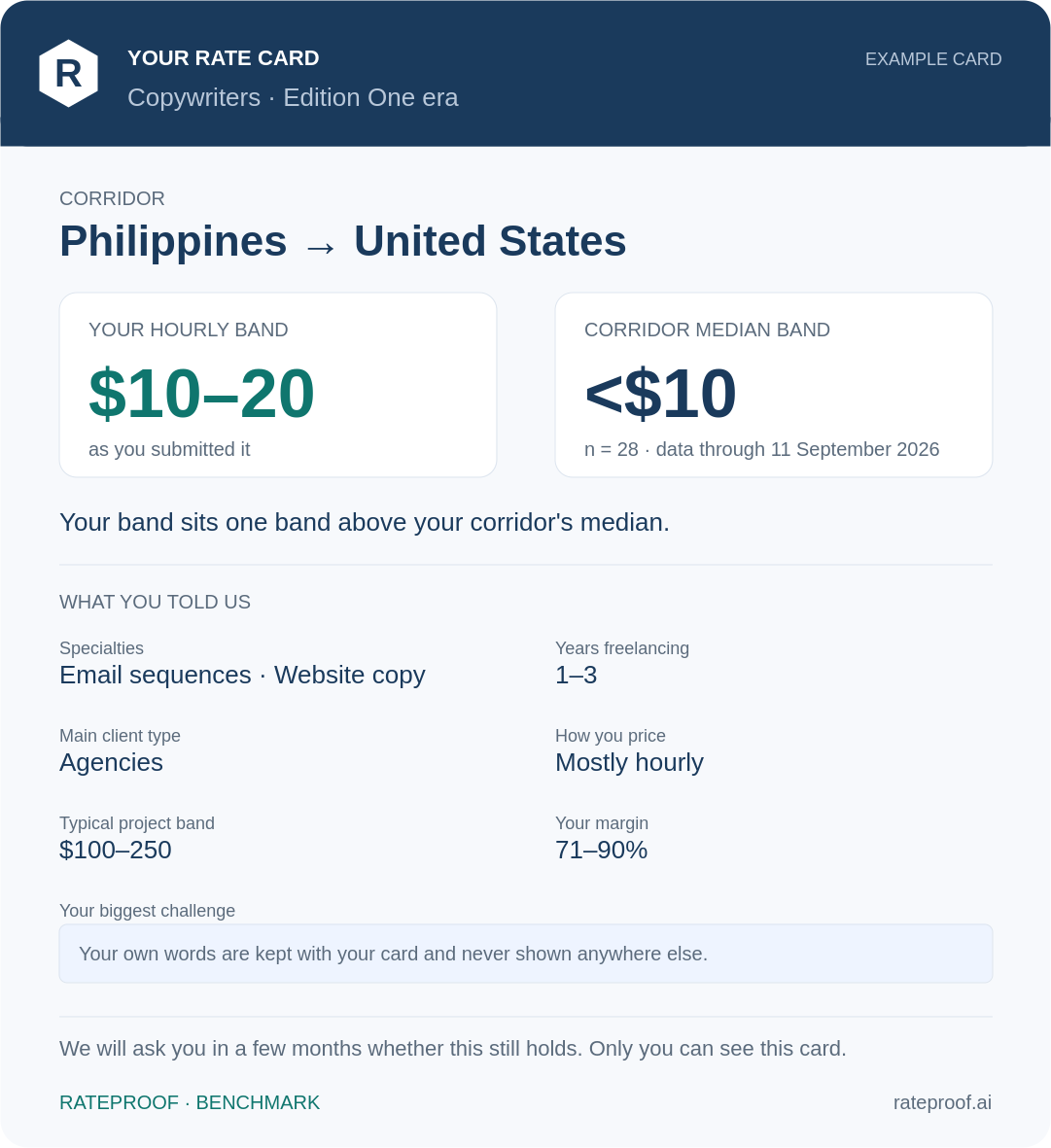
This is what you get when you submit. Example card; every value is one the form offers.
Experience is not buying a higher band
From a first year of freelancing through seven, most submitted rates sit under $20 an hour, and the most common band at every one of those levels is under $10. The few with eight years and more look no different, but there are too few of them yet to say.
The same is true of every specialty: SEO and content, website copy, email sequences, sales pages, ads. Not one of them is mostly above $20.

The ten rate bands the form offers. Dark: where the published medians sit. Light: every band at least one submitter chose. Every band but one has someone in it.
Nothing we ask about is buying a higher band yet. Whether that is the market, the clients, or the form asking the wrong question is something a later edition, with more people and the same people over time, can begin to answer.
How the figures are produced
This edition uses the 112 rates people submitted to Rateproof up to 11 September 2026. We removed our own test entries. Two submissions carry no usable rate band and are not counted.
Rates are collected in bands, not exact amounts. A median band is the band the middle submission falls in. It is not a mean, not an exact rate, and not a point inside the band. Because rates are collected this way, we cannot see how rates are spread inside a band, and more submissions do not change that.
Each submission sits in exactly one client-market group. We only publish a benchmark for a group once enough copywriters in it have submitted a rate. Clearing that floor makes a group publishable, not representative of everyone in that market.
Submitters' written answers about their biggest challenge are read for patterns only. No answer is quoted and none is counted.
The exact rules, and the date this data was locked, are in the Rateproof Covenant.
The full edition is also available as a PDF, generated from the same text as this page: download Edition One (PDF).